
In 2026, building energy efficiency has entered a phase where targets are actually enforced. In April, a national assessment framework for carbon-peak and carbon-neutral performance was introduced, linking local results to official evaluations; national urban-renewal policy likewise calls for “continuing energy retrofits of existing buildings” and “stronger management of building insulation materials”. For factories and industrial parks, the HVAC system is usually the largest energy consumer — and how well the air ducts are insulated is often the first question on the retrofit checklist.
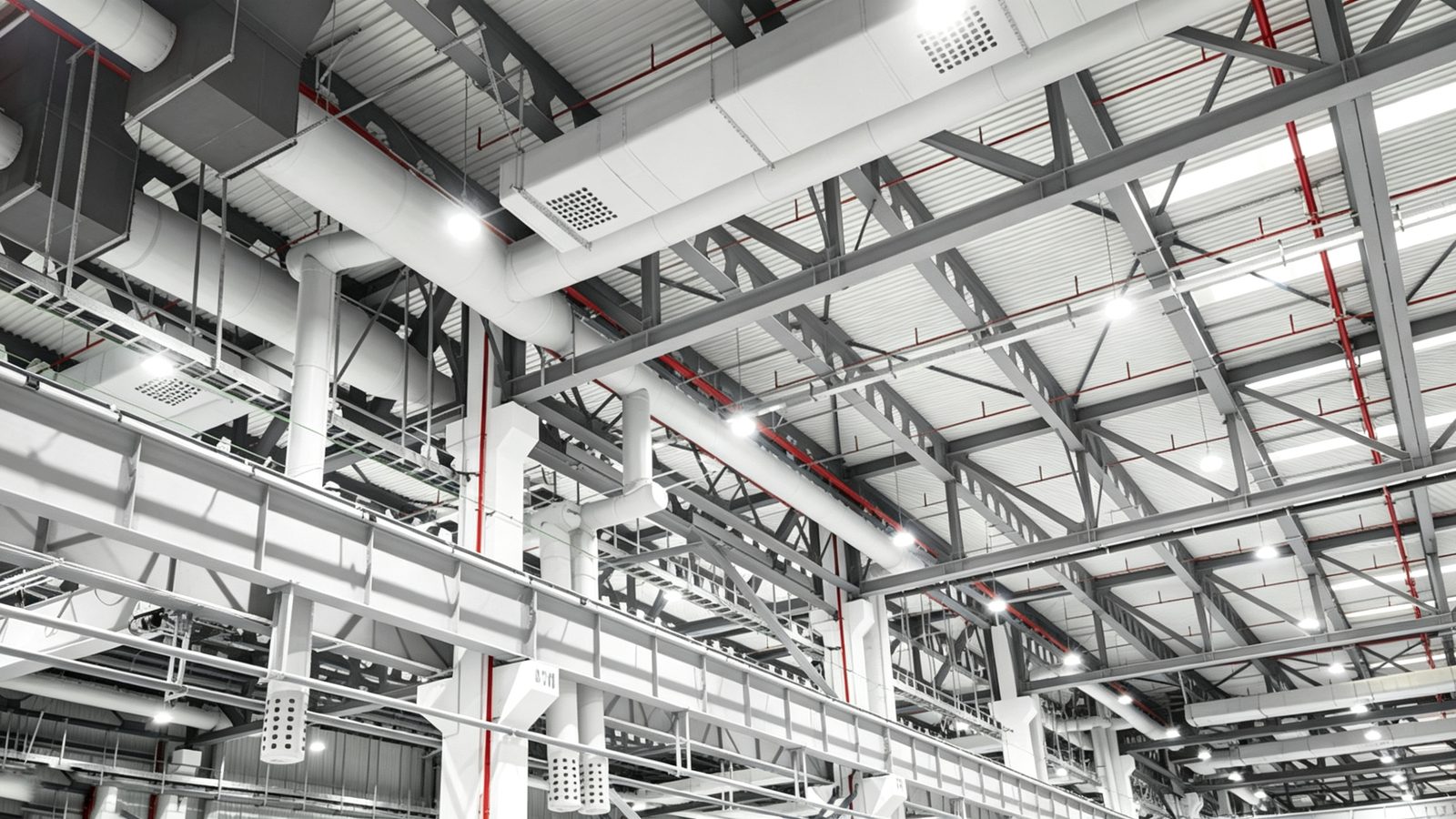
Why Duct Insulation Is “Step One”
When ducts are not insulated, energy escapes in three quiet ways:
- Cold is lost along the run. The longer the supply-air path, the greater the heat transfer through the duct wall, forcing the plant to cool more and use more electricity.
- Condensation drips. With a large temperature difference between inside and outside, the duct wall falls below the dew point and “sweats”, soaking ceilings, while the damp environment breeds mold.
- Leakage mixes the air. Traditional sheet metal ducts have many joints and high leakage rates, so fans work harder and supply-air temperatures drift.
Each of these shows up on the electricity bill — and on the carbon ledger.
Why Traditional Retrofits Are Hard
In the past, adding insulation to sheet metal ducts meant wrapping them with insulation cotton on site: cutting, bonding and edging by hand. The many joints and corners are exactly where “cold bridges” form; once wet, the cotton grows heavier, deforms and degrades year after year. Retrofits often require taking down ceilings and halting production lines — long schedules and high costs. For a factory that cannot afford to stop, that is often the biggest obstacle of all.
The Integrally Molded Insulated Duct Approach
More and more retrofit projects now switch directly to composite ducts whose insulation layer is molded in one piece with the duct body. The typical construction is closed-cell foam — cells are independent, so moisture cannot easily penetrate. In the industry this family goes by various names: insulated duct, insulated fabric duct, cloth duct, bag duct or sock duct — all insulated members of the fabric air duct family.
Compared with wrapped insulation, the advantages map directly onto the pain points of retrofits:
- No wrapping seams, so fewer cold bridges and lower condensation risk;
- Light weight, adding almost no load to the beams and columns of existing buildings;
- Factory prefabrication and fast on-site installation, allowing phased work without stopping production;
- A smooth, cleanable surface — friendly to food, pharmaceutical and other clean environments;
- Coverage of both cold and hot zones: anti-condensation insulation in low-temperature areas, and rubber-plastic insulation material (boards/pipes) can be combined for a complete solution where separate insulation is needed.
Which Projects Benefit First
First, energy retrofits of existing plants and industrial parks — equipment-update policies are releasing budgets and public-building retrofit programs are landing in many regions. Second, cold storage and cold chain, where low-temperature anti-condensation and light structural loads are exactly what insulated ducts excel at. Third, data centers and food plants that are sensitive to temperature and humidity and can least afford downtime during the works.
Conclusion
The carbon transition is a long race, and insulation is the fundamental skill. Rather than wait for the electricity bill to turn ugly, choose the right insulated duct solution at the design or retrofit stage. RyboTex (Nantong) focuses on fiber fabric air ducts and thermal insulation materials, offering free duct selection and design development; fabric duct pricing is customized per project — welcome to enquire online.
Rybotex (Nantong) New Materials Co., Ltd. (brand RyboTex) focuses on fiber fabric air ducts and thermal insulation materials, offering CFD airflow simulation, condensation calculations and full-lifecycle technical services.