
The heat of summer 2026 is written directly into the nation's power-load curve. On August 7, national power demand set a fourth all-time high this summer, reaching 1.557 billion kW - about 4.8 million kW above the previous peak. On the same day, Beijing's grid load surpassed 30 million kW for the first time, roughly the equivalent of 30 million air conditioners running at full cooling. Under extreme heat, air-conditioning and cooling loads are the biggest line on the electricity bill. For factories with wide-span workshops, warehouses and plants, "cooling electricity" is an unavoidable summer cost - and how the ducts are chosen and how air is delivered often decides whether that money is well spent.
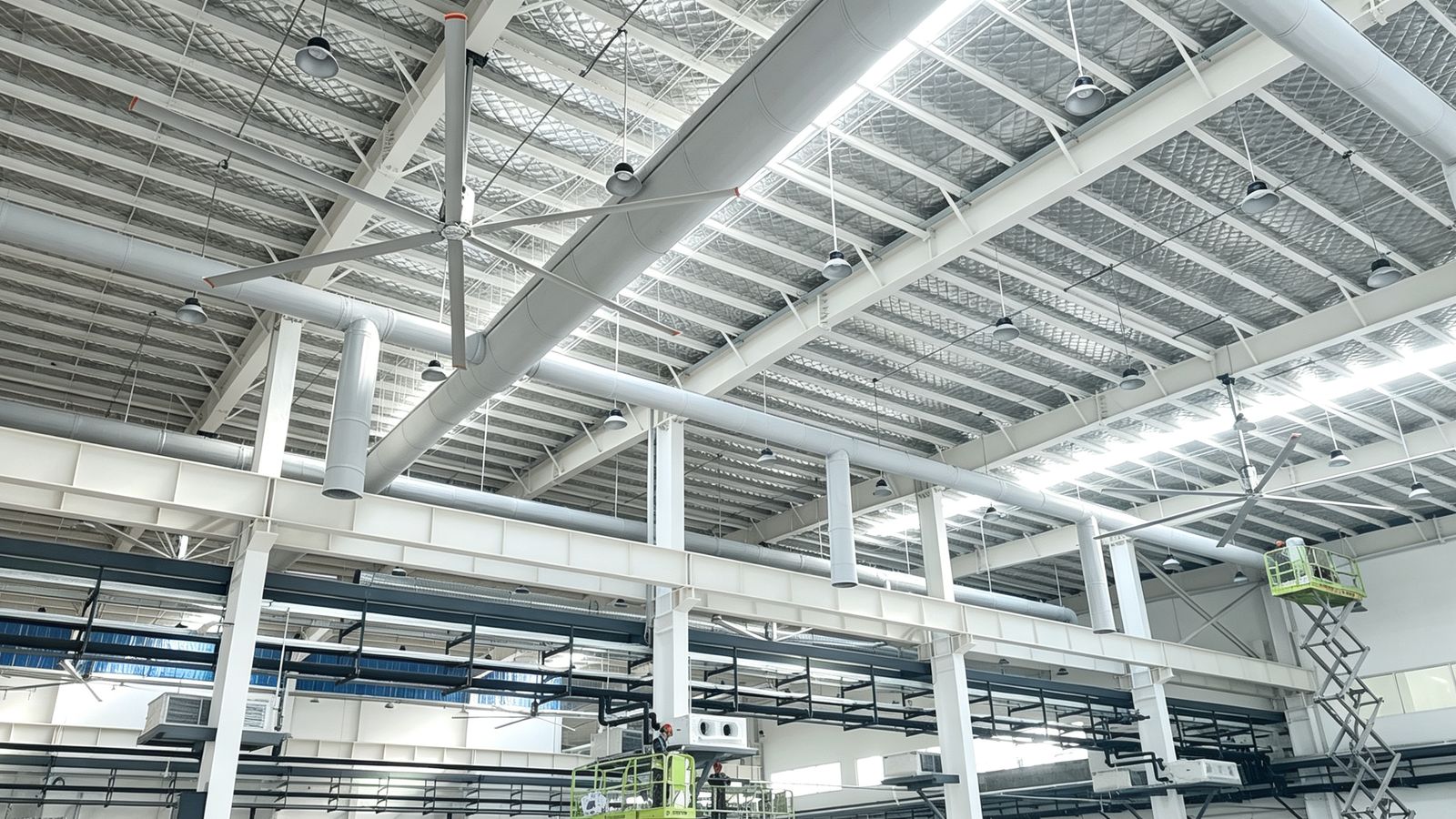
Why Cooling Loads Keep Setting Records
Since early summer, national power demand has broken records again and again - six regional grids, including East China, set 21 all-time highs in total, with air-conditioning and cooling loads accounting for nearly half of peak demand. For factories, cooling demand is rigid: once workshop temperatures exceed limits, equipment precision, product quality and worker performance all suffer.
Large workshops, however, are exactly the hardest spaces to cool - big volumes, high ceilings, and occupied zones concentrated near the floor. Cooling energy easily goes where it is not needed.
Where the Cold Goes: Cooling Large Spaces Is Hard
The traditional sheet-metal duct plus terminal diffuser approach tends to waste energy in three ways inside a workshop:
- Uneven delivery. Airspeed near the diffusers is high and drafty, while the far end never gets enough - "cold in front, hot in the back".
- Thermal stratification. Cold air is dense and pools near the floor while warm air rises to the ceiling; the system responds by forcing more and more airflow.
- Oversized design margins. To guarantee delivery to the far end, static pressure and airflow are inflated, fans run longer at full load, and the bill climbs.
Fabric Air Ducts: The "Equalizer" of Large-Space Delivery
Fabric air ducts (also called fabric ducts, fiber fabric ducts, bag ducts or sock ducts) have become one of the mainstream choices for large-space delivery. The principle is simple: air is discharged evenly along the duct's length through openings or permeable fabric, spreading cooling like a shower head across the whole space.
Compared with traditional diffusers, the advantages map directly onto the waste above:
- Even, low-velocity delivery: smaller temperature gradients in the occupied zone, and cool air reaches the workspace instead of hugging the ceiling;
- Lower running energy: the smooth, flexible fabric wall has low friction, so the fan needs less static pressure and consumes less power for the same cooling;
- Light and fast to install: low dead weight and suspended mounting place negligible load on the structure, keeping retrofit downtime to a minimum.
Insulated Ducts: Don't Let the Cold Leak Out
Half of cooling-energy saving happens during delivery. If the duct wall is not insulated, cold is lost along the whole run - money spent for nothing - and in hot, humid weather the wall can sweat and drip onto products or equipment.
Integrating the insulation layer with the duct body is what the industry calls an insulated duct - also known as an insulated fabric duct, thermal-insulated duct or rubber-plastic fabric duct, part of the family collectively called non-metallic composite flexible fabric ducts. A closed-cell foam insulation layer resists moisture and keeps the cold in: lower transmission loss and less condensation, suitable for both cooling and heating seasons. Insulating the return duct also prevents deformation under negative pressure.
Where This Combination Fits Best
- Wide-span production workshops, warehouses and logistics centers: large-area, even cooling delivered right to the occupied workspace;
- Food processing, precision manufacturing and other temperature- and humidity-sensitive facilities: fast retrofits without stopping production, with gentle air that won't blow materials;
- Sports venues, exhibition halls and other public large spaces: comfort-oriented, more even air distribution.
In one sentence: fabric air ducts deliver evenly; insulated ducts deliver without waste.
Conclusion
Electricity bills tell the truth, year after year. With extreme heat becoming the new normal, instead of paying "tuition" in peak-season bills every summer, start with how air is delivered - put every kilowatt-hour of cooling where people actually work. RyboTex (Nantong) focuses on fabric air ducts, fiber fabric ducts and thermal insulation materials, offering free duct selection and design development; fabric duct pricing is customized per project - welcome to enquire online.
Rybotex (Nantong) New Materials Co., Ltd. (brand RyboTex) focuses on fiber fabric air ducts and thermal insulation materials, offering CFD airflow simulation, condensation calculations and full-lifecycle technical services.