
Have you ever noticed long, cylindrical "fabric bags" hanging beneath the roofs of large factories, gymnasiums and shopping malls? Many people mistake them for decoration — in fact, they are an increasingly common type of supply air duct in modern HVAC systems: fabric air ducts.
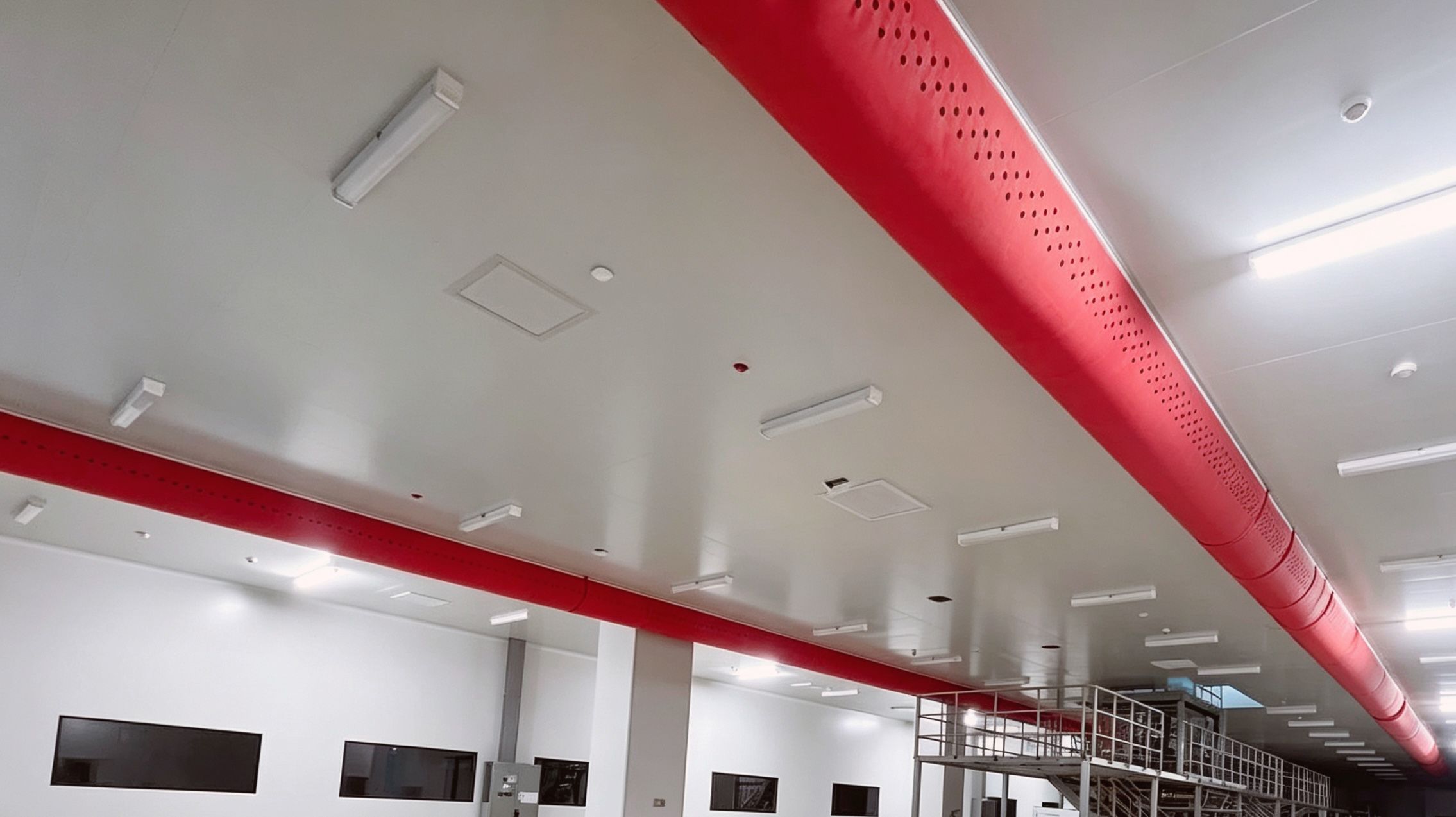
What Is a Fabric Air Duct?
Fabric air ducts — also called cloth ducts, bag ducts, sock ducts, fiber fabric ducts or fabric ductwork — are flexible air distribution ducts made from high-performance polymer fabrics. They replace traditional galvanized sheet metal ducts and deliver conditioned cool or warm air evenly through the entire fabric surface.
The key principle lies in the fabric itself: slits and micro-perforations distributed across the surface, combined with different fabric permeability levels, allow air to "seep out" gently along the whole duct, rather than blowing out from a single outlet like conventional ducts.
Why Are They Better Than Traditional Sheet Metal Ducts?
- More even airflow, better comfort. Conventional ducts supply air from concentrated outlets, creating strong drafts nearby and weak airflow far away. Fabric ducts deliver from the entire surface, achieving supply-air evenness within ±5% — smaller temperature differences and gentle velocities, with almost no direct-draft sensation.
- Extremely light. Sheet metal ducts are heavy and costly, adding real load to factory roofs. Fabric ducts weigh only a fraction of metal ducts and can be hung on lightweight steel cables or aluminum rails, minimizing roof load — ideal for large-span steel-structure plants.
- Anti-condensation from the source. Low-temperature supply air can cause condensation and dripping on duct surfaces. The traditional fix is "metal duct + external insulation wrap", which is labor-intensive and easily damaged. Today’s integrally molded composite insulated ducts compound the rubber-plastic/aerogel insulation layer directly with the fabric; the closed-cell foam structure physically blocks moisture penetration, with thermal conductivity as low as 0.018 W/(m·K), keeping the outer wall above the dew point and eliminating drips at the root.
- More energy efficient. Lighter ducts, lower airflow resistance and better sealing reduce fan energy; better insulation reduces cooling loss — real savings on electricity.
- Fast installation, easy cleaning. Modular zipper connections snap together on site like a zipper — a typical project takes 3 people 3 days. When cleaning is needed, the whole duct can be taken down and washed; cleanrooms can also meet GMP validation requirements.
- Clean look, flexible colors. Multiple colors are available to blend with factory or commercial spaces — visually far more pleasant than rows of gray sheet metal.
Where Are They Used?
- New energy & energy storage plants: large spaces needing fast, even cooling
- Pharmaceutical cleanrooms: antibacterial, antistatic, low particle shedding, meeting GMP / ISO Class 5–8 cleanliness
- Food processing & cold chain: no condensation drip contamination, easy to clean and maintain
- Gymnasiums, shopping malls, cinemas: draft-free, high comfort
- Heavy industry & underground spaces: where fire resistance matters, choose non-combustible types meeting GB 8624 A2/B
How to Choose? A Few Quick Rules
For ordinary workshops and commercial spaces, choose the comfort type; for pharmaceutical, electronics and food workshops, the clean type; for main HVAC ducts where condensation is a concern, the composite insulated type; for underground and high-fire-risk areas, the non-combustible type; for intermittently operated or display spaces where aesthetics matter, the self-supporting round type (which keeps its shape even when the system is off).
Conclusion
Fabric air ducts are not a novelty — they are a mature air distribution technology: more even, more energy-efficient and more hassle-free. If you are planning a ventilation and cooling solution for a plant or commercial space, they deserve a place on your comparison list.
Rybotex (Nantong) New Materials Co., Ltd. (brand RyboTex) focuses on fiber fabric air ducts and thermal insulation materials, offering CFD airflow simulation, condensation calculations and full-lifecycle technical services.