
In factory ventilation projects, you often hear two schools of thought: veteran engineers stick with sheet metal ducts, while younger colleagues recommend hanging "fabric bags" from the roof. What exactly is a fabric air duct? And how does it compare with traditional sheet metal ductwork? This article lays it out from eight angles.
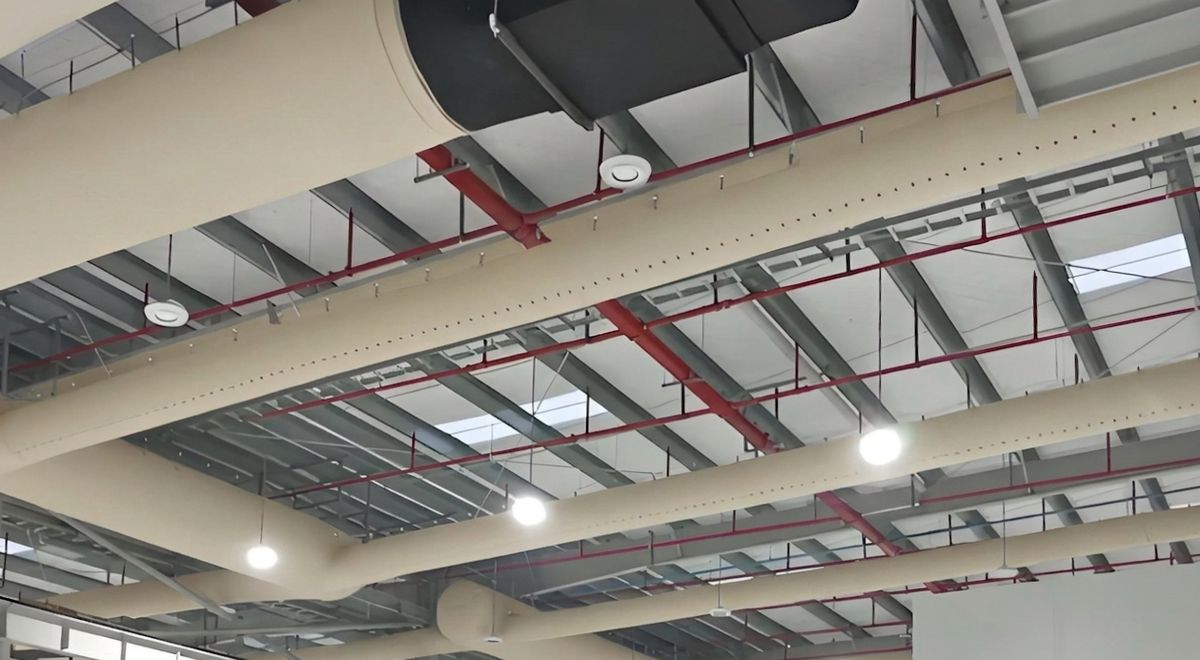
First, the naming: one product, several names
Fabric air ducts — also called cloth ducts, bag ducts, sock ducts or fiber fabric ducts — are the same flexible air supply duct made of high-performance polymer fabric, delivering conditioned air evenly through the entire fabric surface via slots, micro-perforations and permeation.
An eight-point comparison
- Air distribution: Fabric ducts supply air over the entire surface with uniformity within ±5% and no draft at outlets; sheet metal ducts discharge from concentrated outlets, causing uneven temperatures.
- Roof load: Fabric ducts are extremely light — a fraction of the weight of metal ducts; sheet metal ducts are heavy and may require roof reinforcement.
- Condensation: Fabric ducts can be integrally molded with an insulation layer to prevent condensation at the source; sheet metal ducts need external insulation wrap that often fails at the seams.
- Energy use: Fabric ducts have lower resistance, better sealing and insulation, cutting fan and cooling losses; sheet metal ducts lose more.
- Installation speed: Fabric ducts assemble with modular zippers — a typical project takes 3 people 3 days; sheet metal requires on-site fabrication, welding and insulation wrapping.
- Cleaning: Fabric ducts can be removed and machine-washed, meeting GMP validation in cleanrooms; sheet metal ducts are hard to clean internally.
- Fire safety: Fabric ducts are available in GB 8624 Class A2/B non-combustible versions; sheet metal is non-combustible but conducts heat quickly and still needs insulation and fire wrapping.
- Appearance: Fabric ducts come in multiple colors and blend into the space; bare metal ductwork looks industrial.
When to choose fabric air ducts
- Large-span steel workshops and warehouses, where roof load matters
- Large spaces demanding uniform air distribution: gymnasiums, malls, theaters, showrooms
- Central air-conditioning systems prone to condensation dripping
- Pharmaceutical, electronics and food cleanrooms: washable, antimicrobial, anti-static, low particle generation
- Projects on tight schedules: modular zipper assembly is fast
When sheet metal ducts are still the first choice
- High-temperature exhaust and fire-protection ductwork requiring heat resistance and mechanical strength
- High-pressure, high-velocity systems where metal duct pressure capacity and airtightness are more mature
- Exposed areas subject to mechanical impact
- Where existing design codes mandate metal ducts
How to decide — three steps
- Identify your pain points: air distribution uniformity, roof load, condensation, cleaning.
- Check hard constraints: fire rating, temperature, pressure and code requirements.
- Let the numbers decide: give the manufacturer your airflow, static pressure, span and ceiling height for airflow simulation and a side-by-side comparison.
Conclusion
There is no absolute winner — only what fits. RyboTex (Nantong) specializes in fabric air duct systems and provides CFD airflow simulation, anti-condensation calculation and full-lifecycle technical service. If you are weighing options for your plant's ventilation, bring us your project parameters and we will run an objective comparison.
Rybotex (Nantong) New Materials Co., Ltd. (brand RyboTex) focuses on fiber fabric air ducts and thermal insulation materials, offering CFD airflow simulation, condensation calculations and full-lifecycle technical services.