
First, the naming: the fabric air ducts in this article are what the industry also calls cloth ducts, bag ducts or sock ducts.
This summer has been unusually hot. According to China Weather Network, the 2026 sanfu — the 40-day hottest stretch from July 15 to August 23 — posted a national average temperature of 22.95°C, making it the fifth hottest since complete records began in 1961. The weather is not the only thing running hot. Citing market research firm Gartner, a report by the Economic Daily in July projected global data center electricity consumption of 565 TWh in 2026, up 26% year on year; the International Energy Agency (IEA) has floated an even higher estimate of more than 1,000 TWh.
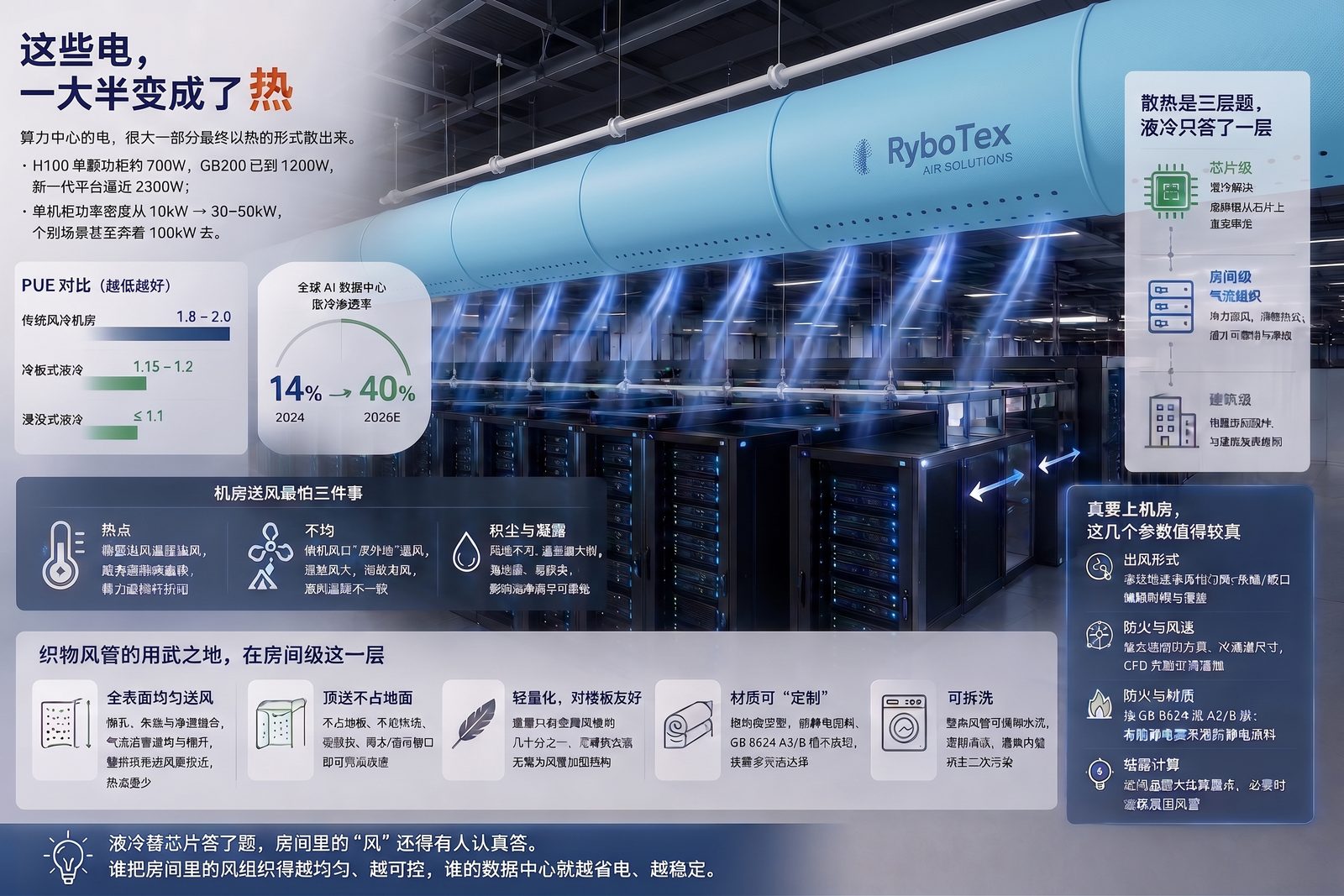
Most of That Electricity Becomes Heat
Much of the power consumed by compute centers ultimately leaves as heat, and chips are the biggest emitters: NVIDIA’s H100 draws around 700 W per chip, the GB200 reaches 1,200 W, and the next-generation platform is approaching 2,300 W. Rack power density has climbed from the traditional 10 kW toward 30–50 kW, with some configurations heading toward 100 kW.
Conventional air-cooled rooms typically run a PUE (Power Usage Effectiveness) of 1.8–2.0 — for every kilowatt spent on computing, nearly another kilowatt goes to cooling. Liquid cooling solves that layer elegantly: cold-plate systems push PUE down to 1.15–1.2, and immersion goes even lower. That is why 2026 is widely called the breakout year for liquid cooling, with penetration in global AI data centers forecast to rise from 14% in 2024 to around 40%.
Cooling Is a Three-Layer Exam, and Liquid Cooling Answers Only One
But heat removal is not a single-choice question. Data center cooling can be divided into three layers: chip, room and building. Liquid cooling answers the chip layer, taking heat directly off the processor. Yet the heat still has to leave the building, and the air inside still has to move. Whether servers are air-cooled or liquid-cooled, uniform rack inlet temperatures, the absence of hot spots, and clean separation of supply and return airflow all determine reliability — and the cooling bill.
That is where room-level air distribution earns its keep: liquid cooling has answered the chip’s question, but someone still has to answer the room’s.
“Air Cooling Is Dead” Is a Misreading
What is fading is the crude role of blasting chips with high-volume air. Room-level supply — delivering treated air evenly to each row of racks — never went away, and does not need to. Three real-world situations lean on it heavily:
- Hybrid cooling rooms. High-density racks go liquid while ordinary racks stay air-cooled, and room-level airflow has to serve both systems at once;
- Retrofits. Older facilities have limited floor-loading capacity and short change windows, and racks cannot switch to liquid overnight — making room-level airflow even is often the cheapest way to lower PUE;
- New builds. Even a fully liquid-cooled hall still needs fresh air, humidity control and aisle airflow.
What Server Room Supply Air Fears Most
- Hot spots. A rack with a warm inlet throttles its CPUs, and computing power is wasted — the most direct loss;
- Unevenness. Conventional point-style diffusers depend on the grille layout matching the rack layout; when they don’t, you get too much air here and none over there;
- Dust and condensation. Uneven velocity and large temperature differences invite condensation near diffusers and dust build-up in dead zones — real risks in a room that cares about cleanliness.
Fabric Ducts Earn Their Keep at the Room Level
- Even, whole-surface supply. Micro-perforations, slits and permeable fabric spread the air along the entire duct. Combined with cold-aisle containment, inlet temperatures across a row of racks become much more uniform and hot spots shrink; low-velocity permeable supply also avoids local temperature swings.
- Overhead supply frees the floor. Space is often the bottleneck in retrofits: raised floors are packed with cabling and there is no floor area left. A fabric duct supplies from above — no floor work, no cable disturbance — and being lightweight it installs quickly, often in a weekend or a night shift. In a room where every minute of downtime hurts, that matters.
- Light on the structure. At a small fraction of the weight of sheet metal ducts, fabric ducts avoid structural reinforcement in buildings with limited load capacity.
- Materials can be specified. Choose insulated fabric to stop duct sweating, antistatic fabric for static-sensitive rooms, and A2/B fire-rated options (GB 8624) where fire codes demand it.
- Washable. The whole duct can be unzipped and washed, so rooms with strict cleanliness requirements can periodically clean the interior instead of re-dispersing dust.
Parameters Worth Getting Right
- Air delivery mode. Choose permeability-first for maximum uniformity; use slits or nozzles where you need throw distance, for example to push air over rack tops before it sinks into the aisle.
- Static pressure and velocity. These must be calculated together with the supply/return scheme and cold-aisle dimensions — a CFD airflow simulation up front is far cheaper than reworking diffusers later.
- Fire rating and materials. Data center fire codes are generally strict; choose A2/B per GB 8624 and antistatic fabric where needed.
- Condensation check. Where supply-air temperature differences are large, confirm the dew point and consider insulated duct.
Conclusion
The hotter compute gets, the more cooling is worth — and cooling has both a chip-level and a room-level exam. Liquid cooling is one of the loudest answers of 2026, but it does not hand in the room’s paper. Whoever keeps the air in the room even and controllable will run a cooler, more efficient, more stable data center. In the age of computing at full throttle, the people who know how to manage air will not lose.
Rybotex (Nantong) New Materials Co., Ltd. (brand RyboTex) focuses on fiber fabric air ducts and thermal insulation materials, offering CFD airflow simulation, condensation calculations and full-lifecycle technical services.