
First, the naming: the integrally insulated duct in this article is the insulated member of the fabric air duct family — also called a cloth duct, bag duct or sock duct.
When summer arrives, the ceilings of many workshops, malls and hotels quietly start to “drip”: water stains appear on the floor and wall surfaces near air outlets become damp. Many people assume there is a leak — more often than not, the real cause is condensation on the outer surface of the air duct.
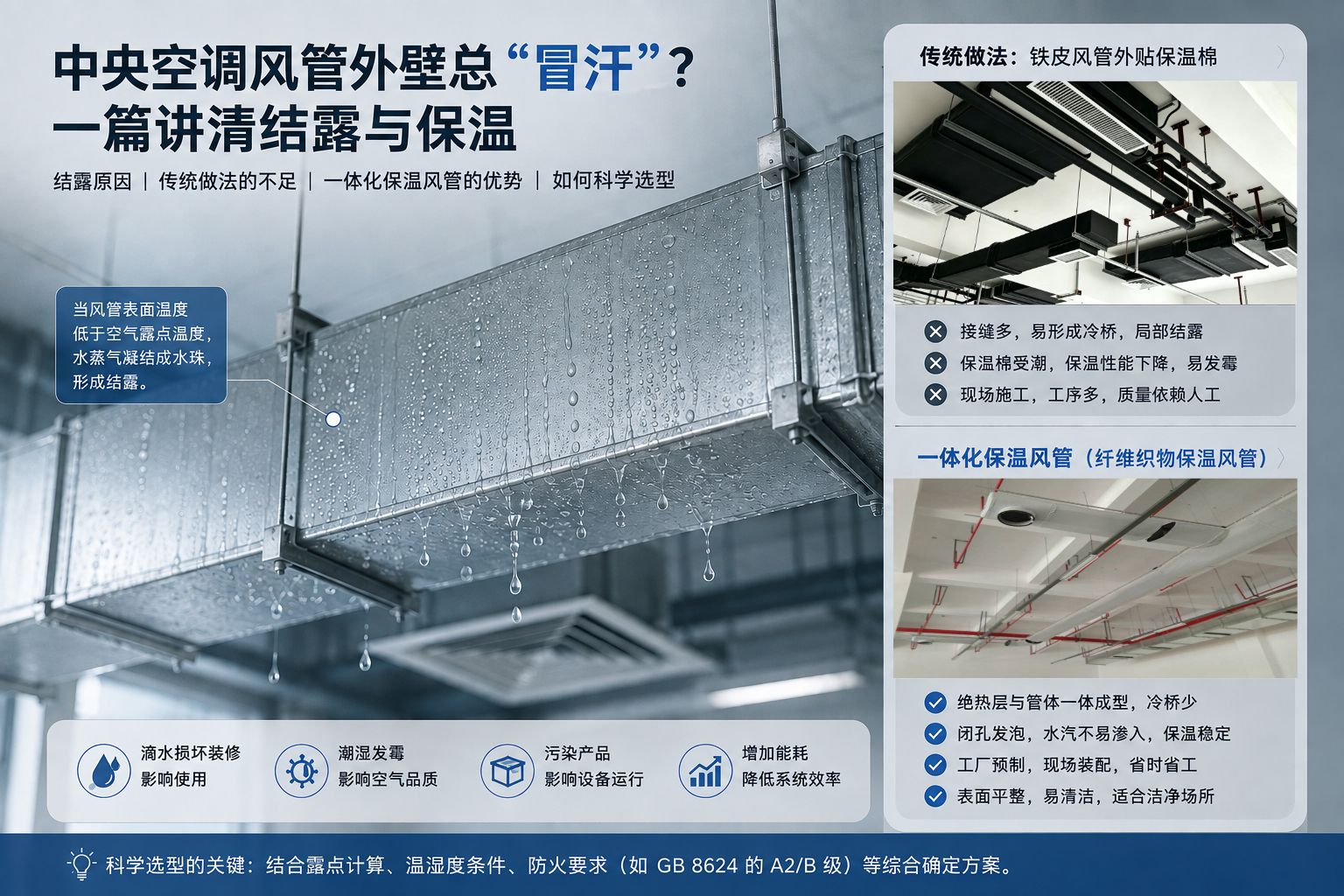
Why Do Ducts “Sweat”?
When an air conditioner supplies air, cold air flows through the duct and pulls down the temperature of the duct wall. When the wall temperature falls below the dew point of the surrounding air, water vapor condenses into droplets on the surface — that is condensation, commonly called “sweating” or “dripping”. The higher the humidity and the larger the temperature difference between inside and outside, the more obvious the condensation.
Condensation is not just unsightly. Long-term dripping soaks ceilings and damages finishes; worse, damp environments breed mold and degrade indoor air quality. In places sensitive to cleanliness — food, pharmaceutical and electronics facilities — condensing droplets can contaminate products and disrupt equipment.
The Traditional Approach: Sheet Metal Ducts Wrapped with Insulation
The most common practice is wrapping metal ducts with a layer of insulation cotton. It separates the duct wall from indoor air and narrows the temperature difference — a sound idea. But in practice, several problems keep appearing:
- First, cold bridges form at seams and damaged areas. Insulation is applied afterwards, with many joints and corners; these areas are unevenly insulated and are often exactly where condensation first appears.
- Second, performance decays when wet. Once insulation cotton absorbs water, it becomes heavier and deforms, and its thermal conductivity deteriorates noticeably; over time it may even grow mold, and insulation performance drops.
- Third, it involves many steps and depends on on-site labor. Cutting, bonding and edging are all manual work, so quality largely depends on the experience of the installer.
Another Approach: Integrally Molded Insulated Ducts
In recent years, many projects have switched to composite insulated ducts whose insulation layer is molded in one piece with the duct body. The insulation is not “stuck on” afterwards but integrated with the duct. A common approach is closed-cell foam — the cells are independent of each other, so moisture cannot easily penetrate, physically cutting off the moisture source of condensation.
The advantages of such solutions: no seam weak points like wrapped insulation, so fewer cold bridges; closed-cell foam is less affected by moisture, so insulation performance stays stable; factory prefabrication and on-site assembly eliminate the on-site wrapping process; and the smooth surface is easy to clean — friendly to cleanrooms.
It should be noted that integrally molded construction is not the only right answer. The choice depends on the project: how humid the ceiling space is, how large the temperature difference is, and whether there are cleanliness or fire-safety requirements — all should be determined with dew-point calculations and project codes. For example, in areas with high fire-safety requirements, insulation materials must meet the corresponding burning rating (such as A2/B per GB 8624), and fire performance should take priority in material selection.
Conclusion
Condensation on ducts looks like a minor issue, but if mishandled it affects comfort, energy use and the cleanliness of the environment. Rather than reworking after the ceiling starts dripping, it is better to choose the right insulation solution at the design stage — whichever process you use, the key is to seal off the two sources of condensation: cold bridges and moisture absorption.
Rybotex (Nantong) New Materials Co., Ltd. (brand RyboTex) focuses on fiber fabric air ducts and thermal insulation materials, offering CFD airflow simulation, condensation calculations and full-lifecycle technical services.